
In scenarios such as nursing homes, rehabilitation hospitals and home care, patient lifts are core assistive devices for transferring people with disabilities. The safety of the patient lift is directly related to the lives of patients and the health of caregivers. When purchasing a patient lift, you should not only refer to the load capacity and price. Multiple redundant safety configurations are the core to avoid risks such as falling, tipping over and power failure. Taking the CareAge electric patient lift as an example, a qualified model that meets the ISO 13485 medical device standard must be equipped with five categories of core safety protection devices.
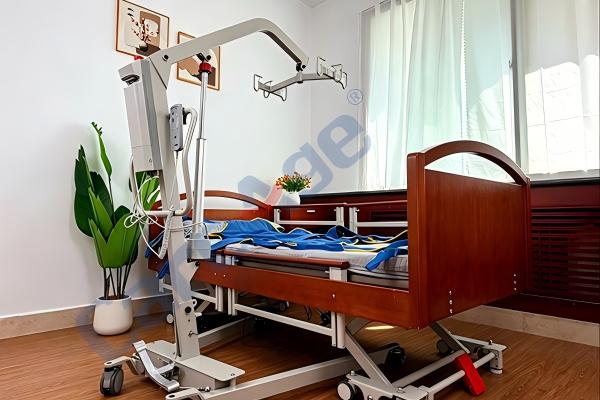
First, the multi-layer power failure emergency protection system. The electric patient lift is equipped with a standard external red emergency stop button, which can lock the lifting action with one press in case of abnormalities such as shaking or jamming. The patient lift also has a built-in manual pressure relief lowering device. In the event of a complete power failure or motor failure, caregivers can manually lower the patient at a constant speed to eliminate the safety risk of the patient being stranded in mid-air.
Second, the anti-tip stable chassis and four-wheel independent braking system. The electric patient lift adopts a widened and retractable support base to lower the overall center of gravity, greatly reducing the probability of tipping over. The four universal wheels are equipped with independent foot-operated locking brakes, which can fix the machine body before transfer to prevent the machine from sliding during the transfer process.
Third, the high-strength double-safety sling and anti-fall hook. The sling is made of medical-grade wear-resistant thickened fabric, with double-thread reinforced stitching, and has passed tests of several times the rated tensile force. It has dedicated styles for full-body transfer, toileting and bathing. The 4-point/6-point locking hook is matched with an anti-release buckle, and the lifting function can only be started after the buckle is properly fastened, which effectively prevents the sling from loosening and slipping off.
Fourth, the closed-loop electronically controlled safe operation system. The handheld controller of patient lift adopts a dual-operation logic that stops immediately when released, which prevents continuous lifting caused by accidental touch. The patient lift is equipped with a real-time power display and low-power warning to avoid power failure halfway during the transfer.
Fifth, the compliant overall structure and safety certifications. The thickened steel frame has stable welds without deformation, and key load-bearing components have reserved safety margins. The whole electric patient lift has passed the medical electrical safety certification, is equipped with clear load-bearing and operation warning signs, and the quality inspection records of the equipment are traceable, which meets the compliance requirements for institutional procurement and long-term home use.
Care is no trivial matter, and safety is the bottom line. CareAge sets emergency power failure response, anti-tip, anti-fall and overload protection as the basic product standards for the electric patient lift. With multiple safety redundancy designs, it comprehensively eliminates transfer hidden dangers, making both batch care in institutions and single-person home care more reassuring and worry-free.