
Nursing home patient hoists are essential equipment for the safe transfer of disabled and semi-disabled elderly residents. When selecting a hoyer lift, focus on four core dimensions: Safety, Adaptability, Durability, and Efficiency—all tailored to the specific needs of a nursing home environment.

1. Safety
Residents in nursing homes vary greatly in body weight, so a safety margin is essential. The recommended load capacity of a hoyer lift should be no less than 200kg to accommodate both average-weight and heavier residents. Also inspect the frame material of patient hoist—opt for thickened high-strength steel construction that is rust-resistant and deformation-proof. This ensures the patient hoist won't loosen with long-term, high-frequency use, eliminating risks of tipping or structural failure from the source.
2. Adaptability
Rooms and corridors in nursing homes are typically narrow, so hoyer lift flexibility is key:
Adjustable base width: narrow setting to pass through tight doorways, wide setting for enhanced stability.
Agile steering & silent wheels: to avoid disturbing residents' rest.
If the hoyer lift needs to be shared across multiple rooms or storage space is limited, a foldable patient hoist is the better choice—the patient hoist folds to a compact size, saving valuable storage space.
3. Durability
Sling compatibility: patient hoist is equipped with slings suited to different body types—soft, breathable, and evenly distributing pressure to avoid skin compression injuries.
Safety features: the hoyer lift must be included an emergency stop button, anti-tip design, and sling imbalance alarm.
Ease of operation: large, clear control buttons that caregivers can master with minimal training, improving care efficiency.
4. Efficiency
For high-frequency daily transfers (e.g., bed→wheelchair, toileting, bathing), an electric patient hoist is the priority choice. A single charge supports 60+ transfers, with one-touch lifting/lowering and smooth operation—significantly reducing caregivers' physical workload. In emergencies, the patient hoist also supports manual lowering for added safety.
For budget-conscious or low-frequency scenarios, a manual hydraulic hoyer lift is ideal—no power source needed, simple maintenance, high cost-effectiveness, and fully meets basic transfer needs.
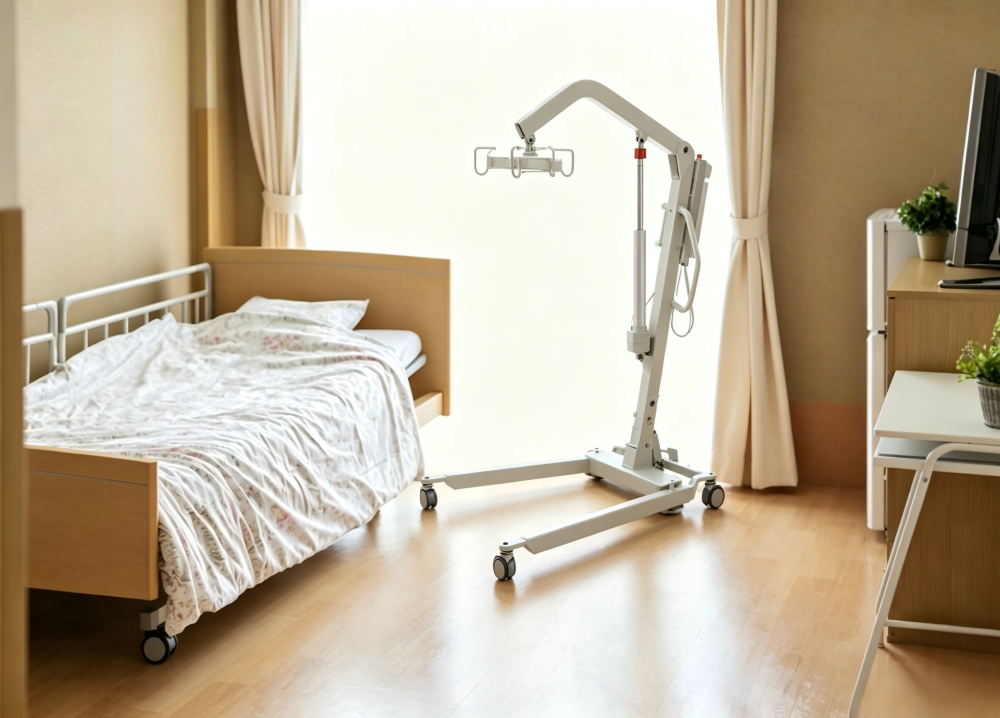
With years of deep expertise in elderly care equipment, CareAge offers three hoyer lift models precisely matched to the diverse needs of nursing homes:
Electric patient hoist: Hospital-grade safety standards, 200 kg load capacity, anti-collision sensors & emergency lowering function. A single charge covers a full day of care, drastically reducing caregiver workload.
Manual Hydraulic hoyer lift: Premium hydraulic pump for effortless operation, thickened steel frame for sturdiness and durability. No power required—ideal for areas without outlets or as a backup. High cost-effectiveness with low long-term maintenance costs.
Foldable hoyer lift (Deneb Series): Quick-fold design for easy mobility and storage. Takes up minimal space—perfect for multi-room rotation or small-to-medium nursing homes, balancing practicality with flexibility.
If you have needs for procurement, bulk ordering, or sample trials of hoyer lifts, please feel free to DM us anytime. We are committed to providing you with cost-effective purchasing solutions and attentive service!