
Selecting a user-friendly Patient Hoyer Lift hinges on matching it to the patient's specific condition, usage scenarios, and care requirements. Overall, a "good" Patient Hoyer Lift should possess four core qualities: safety, effort-saving, comfort, and ease of operation.
1. Choose the Type Based on the Patient's Abilities
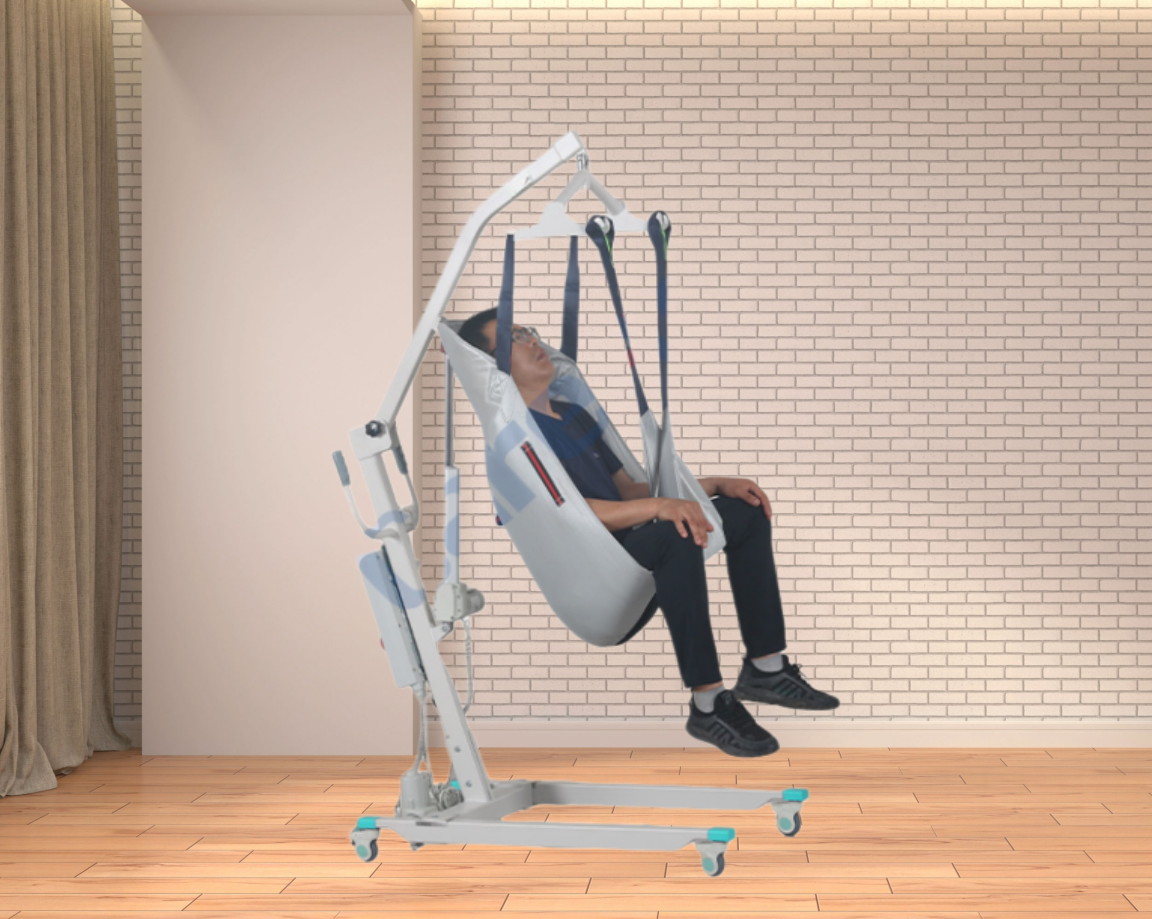
For severely paralyzed patients who are completely unable to move on their own: An Electric Hoyer Lift is the top choice. It can safely and smoothly complete transfers from the bed to a wheelchair, toilet, etc., through electric lifting, rotation, and sliding functions, significantly reducing the burden on caregivers and preventing secondary injuries.
For patients with some upper limb strength or those requiring short-distance transfers: Hydraulic Patient Hoist can be considered. Hydraulic Patient Hoist is relatively inexpensive but require caregivers to have a certain level of physical strength. Sling-type lifts offer high safety but require professional training for operation.
2. Core Performance Indicators
Load-bearing Capacity and Body Type Matching: Don't just focus on the stated maximum load-bearing capacity; also consider the patient's actual weight, body shape, and center of gravity. For patients who are overweight or have lower limb edema, choose a Patient Hoyer Lift with a widened seat cushion, a reinforced chassis, and a dual hydraulic rod structure to ensure stable and wobble-free lifting.
Lifting Smoothness and Control: A good Patient Hoyer Lift should have a uniform lifting speed, free of jerks and abnormal noises. The buttons on the electric remote control should provide clear feedback and have anti-misoperation designs. The manual crank handle should be smooth and effort-saving. A minimum ground clearance of 3 - 5 centimeters is the golden standard to ensure smooth access to toilets or under beds.
Wheel and Steering Flexibility: It must be equipped with omnidirectional casters and be able to rotate 180 degrees in place to adapt to narrow home environments. Soft rubber wheels are recommended for their quiet operation, shock absorption, and floor protection. The wheel diameter should be ≥12 centimeters to avoid getting stuck on carpets or thresholds.
Seat and Sling Comfort: The seat cushion of Electric Hoyer Lift is not the softer the better. A combination of high-resilience foam and breathable mesh fabric provides both support and ventilation. The backrest should have a reasonable curve to support the lumbar spine. The sling of Electric Hoyer Lift must be wide, thick, soft, and free of metal fasteners to avoid skin abrasions or clothing snags.
3. Operational Convenience and Space Adaptation
Remote Control and Operation: The remote control of Electric Hoyer Lift should be comfortable to hold, with large, raised buttons for easy operation by elderly people or caregivers with poor eyesight or hand strength.
Folding and Storage: The folded width of Electric Hoyer Lift should be less than 65 centimeters to easily pass through doors, elevators, and corridor corners. The folded height should be below 90 centimeters to fit under beds or beside wardrobes.
Environmental Adaptation: Ensure that the equipment can seamlessly connect with commonly used furniture at home, such as toilets, nursing beds, and sofas. Some high-end Electric Hoyer Lifts support multi-scenario transfers and are suitable for institutions or large households.
Would you like to select a user-friendly Patient Hoyer Lift? Click on www.careagehc.com, and CareAge will help you choose the most suitable Patient Hoyer Lift.