
For hospitals looking to safely transfer patients with limited mobility, patient hoists are the ideal solution. They greatly cut labor costs and mitigate safety hazards. However, an improper choice will lead to wasted investment. This guide clarifies the core factors for selection.
1. Why Electric Patient Lifts Have Become a Must-Have
Manual handling poses two major problems: nursing staff are prone to lumbar strain, and patients may suffer secondary injuries from improper moving. Powered by motors and optimized mechanical structures, electric patient lifts reduce patient transfer time between beds and wheelchairs by 80% while preventing secondary injuries. Most modern models feature fully automatic controls. Note that electric patient lifts are not suitable for all scenarios, and manual patient hoists offer better flexibility in certain cases.
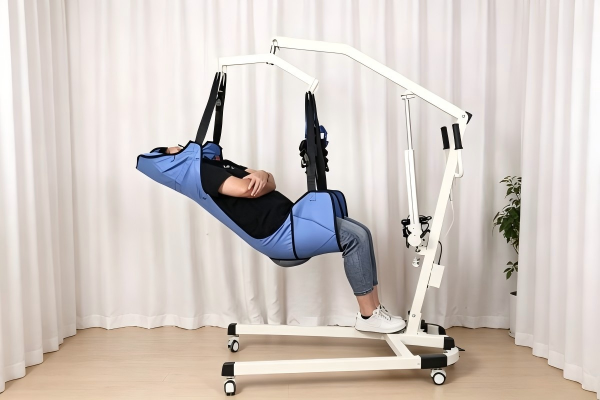
2. Working Principles & Classification
They are divided into two categories by power transmission:
· Hydraulic patient hoist: Enables smooth lifting and moving via hydraulic cylinder pressure.
· Motor drive: Lifting and lowering operations are controlled by digital programs.
3. Selection Based on Actual Needs
| Type | Application Scenarios | Key Specifications |
| Ceiling-Mounted Medical Lift | In-room patient transfer | Silent casters & dual safety locks |
| Floor-Standing Patient Hoist | Home rehabilitation | Lifting range:400-1750mm |
Prioritized features for medical use
· Medical patient hoists shall be equipped with anti-slip padded seats and universal silent casters.
· Electric patient lifts are recommended with one-touch lifting function.
4. Essential Supporting Accessories
Three commonly overlooked accessories after purchasing the main unit:
· Lifting system: Polyester slings with a load capacity of 204kg are required.
· Control module: Equip the remote controller with two spare batteries to avoid power failure.
· Transfer aids: Square slings hold patients in position more securely than round ones.
5. Common Notes for Operation
Two operators are required when the lifting height exceeds 60cm.
The washing water temperature for slings shall not exceed 40°C.
Stop using the device immediately once the low-battery alarm is triggered.
When choosing patient hoists, you need to balance three core factors: safety performance, working efficiency and overall cost.
CareAge specializes in the R&D and production of patient hoists. Our products are sold to more than 50 countries worldwide. We maintain zero after-sales issues and zero complaints thanks to reliable quality. We are recruiting agents on an ongoing basis with favorable cooperation policies. Welcome to contact us for cooperation.