
Moving bedridden seniors is one of the biggest headaches for caregivers. Shifting them between bed and wheelchair or repositioning them to turn over strains your lower back badly, and improper handling can easily injure them. In the past, transfers relied entirely on manual lifting; even two people struggled to carry patients, leaving the elderly in obvious discomfort and pain. After switching to an Electric Patient Lift, countless practical care challenges are solved—once you use it, you'll never want to go back.
Electric hoyer lift are widely deployed in hospitals, nursing homes and private households to reposition mobility-impaired seniors. They fall into three core types by functional design:
Flat-lay models: Designed for short-distance transfers of critically ill patients
Sit-to-stand models: Equipped with adjustable seats to drastically cut caregiver workload
Axillary support models: Securely hold patients under the armpits, an excellent choice for caregivers with bad backs
Based on their operating mechanisms, electric patient lifts are categorized into four styles covering nearly all care scenarios:
Seat-style: Provides direct support under the hips
Standing-assist style: Helps users practice standing rehabilitation
Wrap-around sling style: Uses mechanical arms to cradle the patient's torso
Overhead sling style: Perfect for fully immobile bedridden individuals
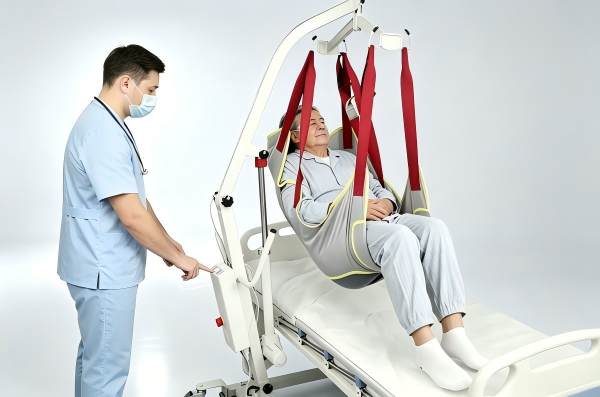
Operation is remarkably straightforward. Fitted with electric push rods and a motorized lifting system controlled by a handheld remote, the electric hoyer lift features minimal, logically laid-out buttons for one-touch lifting and rotation. Control panels adopt large text and oversized icons; certain models are simple enough for seniors to operate independently. The electric hoyer lift folds flat for compact storage against walls when not in use.
Comprehensive safety features are built into every unit: emergency brakes of electric patient lift prevent unintended sliding, anti-slip slings evenly distribute body pressure, auto-lock mechanisms stop accidental slippage, and an emergency stop button enables safe controlled descent during power outages. Constructed from high-strength carbon steel or stainless steel with electrostatic spray coating, many motors carry waterproof ratings for reliable, worry-free daily use.
Home-use electric hoyer lifts deliver outstanding practicality, fitting neatly into confined spaces such as bedrooms and bathrooms. Electric patient lifts are especially suitable for long-term bedridden seniors and post-surgery recovery patients. The foldable structure allows single-person operation, eliminating the constant need for hired caregivers while protecting the patient's privacy. For families unable to afford full-time professional care, this electric hoyer lift offers exceptional cost performance. Hospitals and nursing facilities also rely heavily on these electric patient lifts to quickly transfer patients between hospital beds, wheelchairs and examination rooms, boosting workflow efficiency and reducing care-related injuries and disputes.
Beyond easing physical strain on caregivers, electric patient lifts safeguard seniors' dignity. Users gain autonomy over their movements instead of relying on others for every transfer, greatly easing psychological distress. Constant technological upgrades have refined human-centered functions, revolutionizing elderly care for the better.
Has anyone here used electric hoyer lift at home? What's your experience like?