
For elderly individuals with limited mobility, getting out of bed is never a simple task but rather a challenging endeavor fraught with risks. Declining muscle strength, stiff and immobile joints, and a diminishing sense of balance make every attempt to get out of bed potentially hazardous, with falls being a constant threat. Traditional nursing beds with limited functionality not only fail to provide effective assistance but can even exacerbate the difficulties faced by the elderly. Relevant data indicates that globally, over 300,000 elderly people suffer severe injuries from falls while getting out of normal nursing bed each year, with the process of transferring from the bedside being a particularly high-risk area for nursing accidents. How to enable the elderly to get out of bed safely and with dignity has become an urgent issue that needs to be addressed in an aging society.
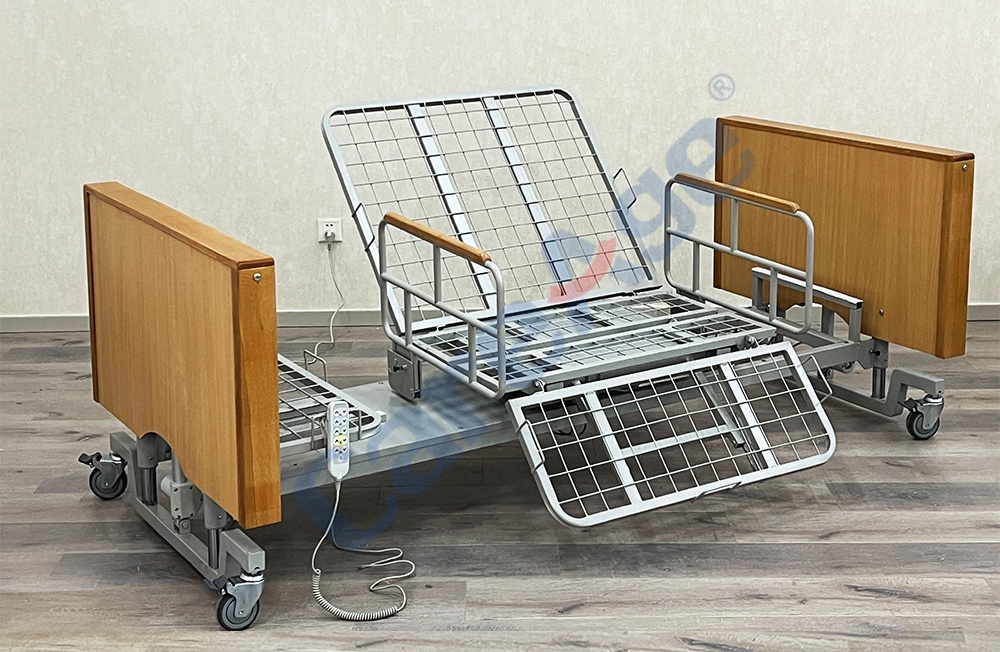
In response to this demand, CareAge has redefined nursing standards with its new generation of Rotating Nursing Beds, guided by the concept of "proactive prevention." Its core functions are achieved through precision machinery and intelligent control:
Backrest Adjustment (0 - 80°±5°): The rotating nursing bed supports a seamless transition from a lying position to a sitting position, working in tandem with the leg rest to help the elderly gradually build up trunk support strength.
Leg Rest Adjustment (-75°- 40°±5°): The negative angle design can simulate the action of "sitting up with bent knees," reducing the load on the lower back, while the positive angle promotes blood circulation in the lower limbs and helps prevent venous thrombosis.
Trendelenburg Adjustment (0 - 15°±3°): The rotating nursing bed assists the elderly in turning from a supine to a lateral position by tilting the head of the bed, reducing the resistance during turning.
Reverse Trendelenburg Adjustment (0 - 15°±3°): The design of tilting the foot of the rotating nursing bed helps the elderly stabilize their center of gravity after sitting up, preventing backward falls.
Height Adjustment (370mm - 800mm±10mm): The lowest height of 370mm brings the rotating nursing bed close to the ground, facilitating the elderly in touching the ground with their feet and standing up independently; the highest height of 800mm makes it easier for caregivers to operate and reduces the risk of back strain from bending over.
After a community nursing home in South Korea introduced CareAge's rotating nursing beds, there was a significant improvement in nursing efficiency. Some patients with Alzheimer's disease, who previously required 24-hour care due to frequent falls, were able to complete the entire process of sitting up, touching the ground with their feet, and standing up independently with the help of caregivers using the remote control. Data shows that the number of bedside fall accidents in the institution decreased by 65%, the time required for individual nursing care was reduced by 40%, and the rate of back strain among caregivers dropped by 33%.
From passive care to proactive prevention, CareAge's rotating nursing beds, with their integration of mechanical precision and humanistic care, offer a replicable solution for the global aging society. It is not just a nursing bed but also a technological partner that helps the elderly regain their freedom of movement and uphold their dignity.
Contact us if you want to know more.